Key Takeaways
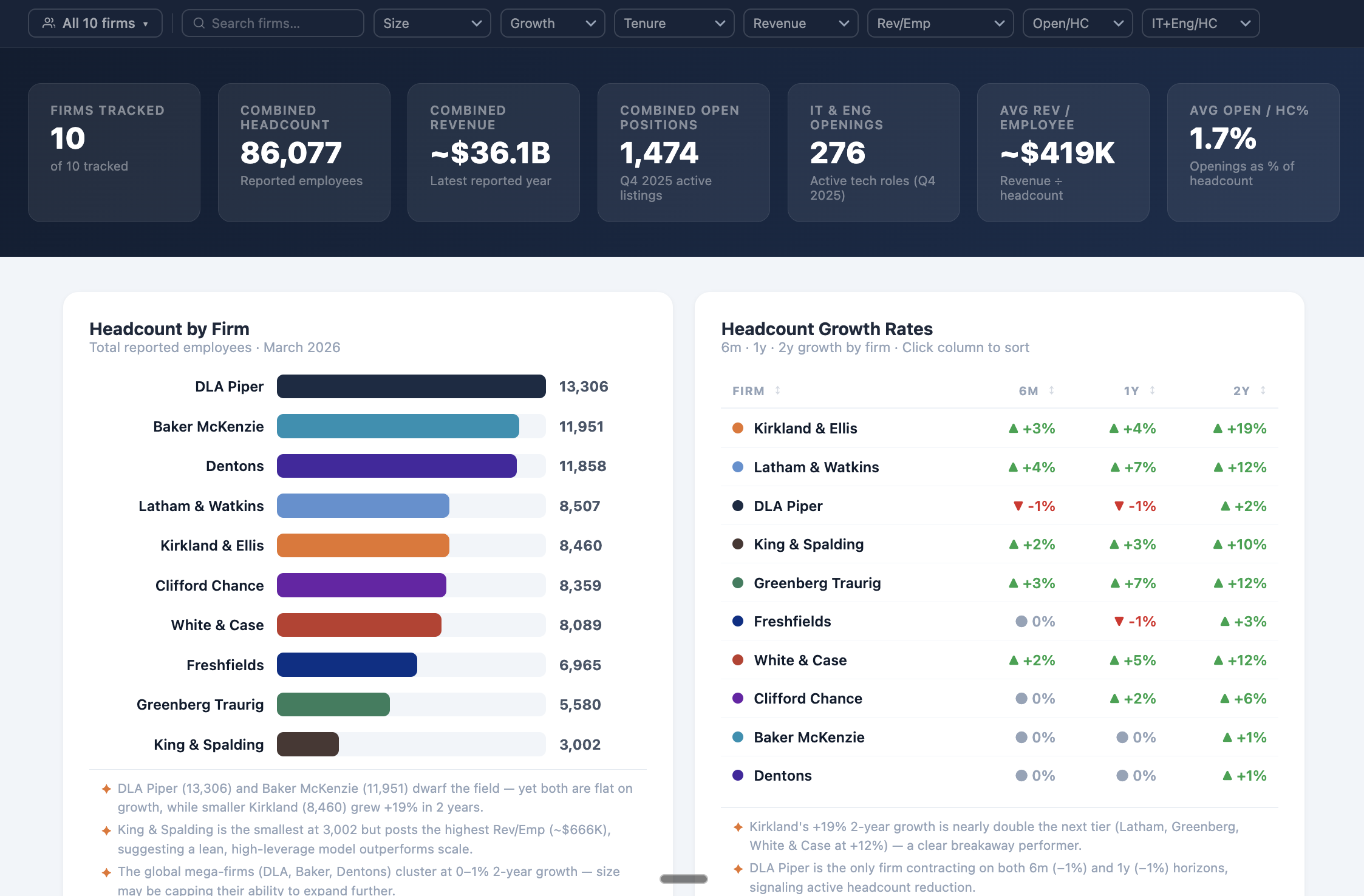
- Hiring intensity varies 16x across firms, ranging from 0.5% to 8.3% of headcount in open roles
- Engineering and IT job openings are surging at triple-digit rates, signaling an industry-wide tech buildout
- The three largest global firms (DLA, Baker, Dentons) have effectively frozen headcount growth
- Revenue per employee ranges from $286K to $768K, a 2.7x gap that's widening
1 Broader tech hiring is exploding across big law
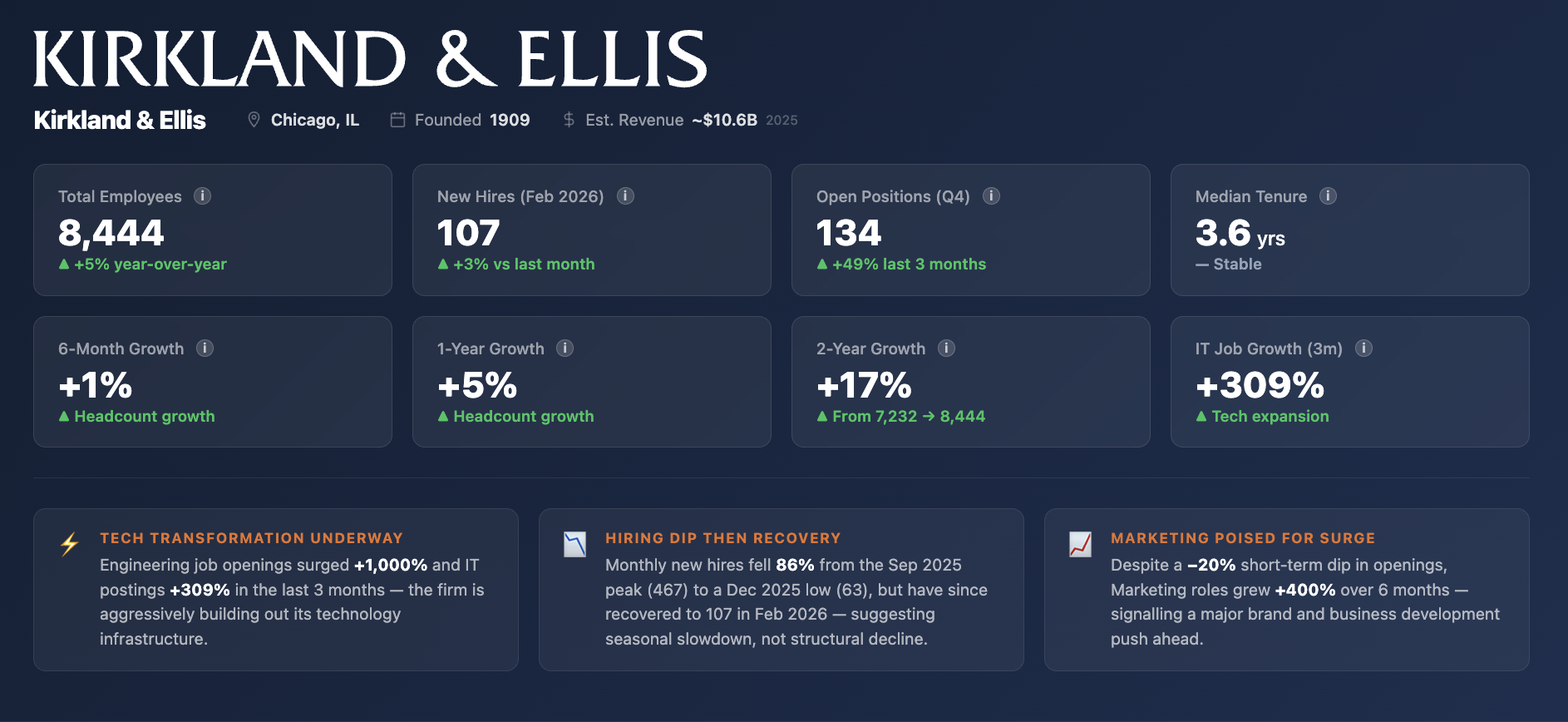
The most dramatic signal in the data isn't about lawyers. It's about engineers. Kirkland & Ellis increased Engineering job openings by +1,000% in three months. Freshfields is up +300%, Clifford Chance +300%, and Baker McKenzie +600% (from a near-zero base).
IT openings are surging too: Kirkland +309%, Freshfields +267%, Greenberg Traurig +181%. The only outliers pulling back on tech are White & Case (IT -80%) and Baker McKenzie (IT -75%), both of which appear to be in broader hiring freezes.
This isn't a coincidence. Law firms are racing to build technology infrastructure for AI-powered document review, contract analysis, and operational efficiency. The firms investing now are placing a bet that technology will be a lasting competitive advantage.
2 Law firms are hiring for AI roles that didn't exist two years ago
Scroll through LinkedIn job listings at top law firms and you'll find a category of roles that simply didn't exist before 2024. Kirkland & Ellis is hiring "Innovation Data Scientists" and "Innovation AI Developers" across New York, San Francisco, Chicago, and Houston. These aren't IT support roles. The job descriptions reference RAG pipelines, LLM evaluation frameworks, Azure OpenAI, LangChain, and Kubernetes.
Greenberg Traurig has posted 10+ "Innovation Manager, Applied AI" roles across 6 US cities. The role: roll out generative AI to attorneys, design practice-specific workflows, and measure adoption.
Latham & Watkins has created entirely new titles: "Legal Workflow Engineer," "AI Services Attorney," and "Manager of AI & Innovation." The Workflow Engineer role requires prompt engineering expertise alongside knowledge of legal practice.
| Firm | Role | Locations |
|---|---|---|
| Kirkland & Ellis | Innovation Data Scientist, Innovation AI Developer | NYC, SF, Chicago, Houston |
| Greenberg Traurig | Innovation Manager, Applied AI (10+ openings) | 6 US cities |
| Latham & Watkins | Legal Workflow Engineer, AI Services Attorney | NYC, LA, Boston, Menlo Park |
| King & Spalding | Legal GenAI Platform Specialist (Harvey) | London |
| White & Case | Senior Engineer, AI Applications Development | Tampa |
| DLA Piper | AI Solutions Engineer | Reston, VA |
| Clifford Chance | Legal Technology Advisor (Forward Deployed) | London |
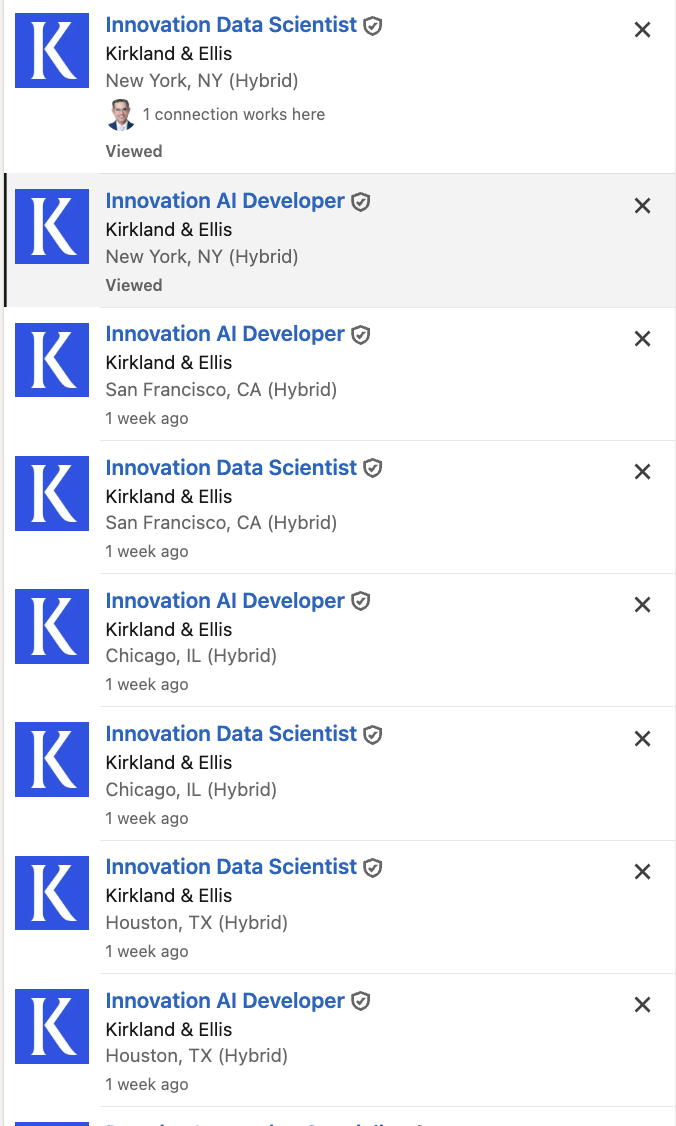
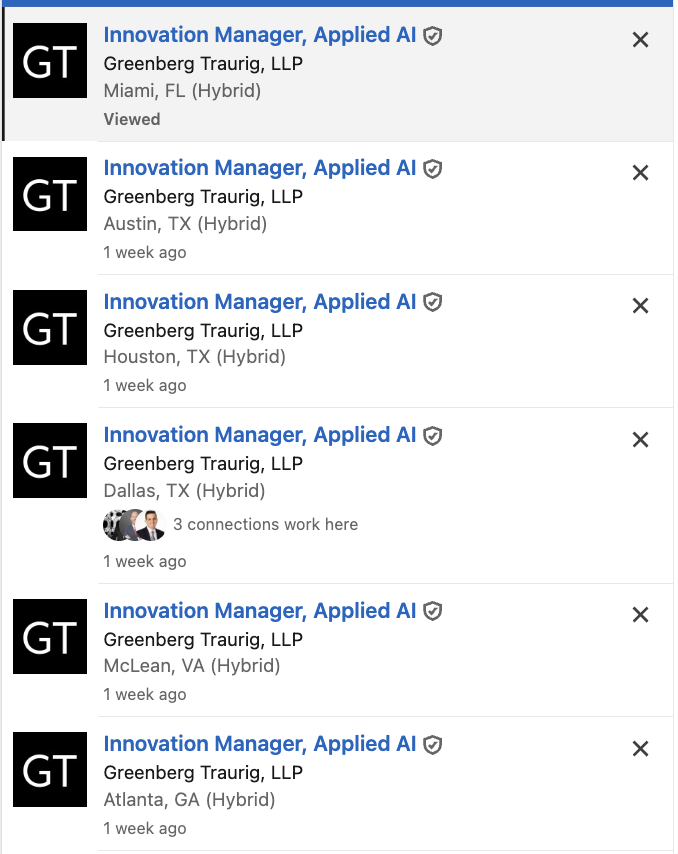
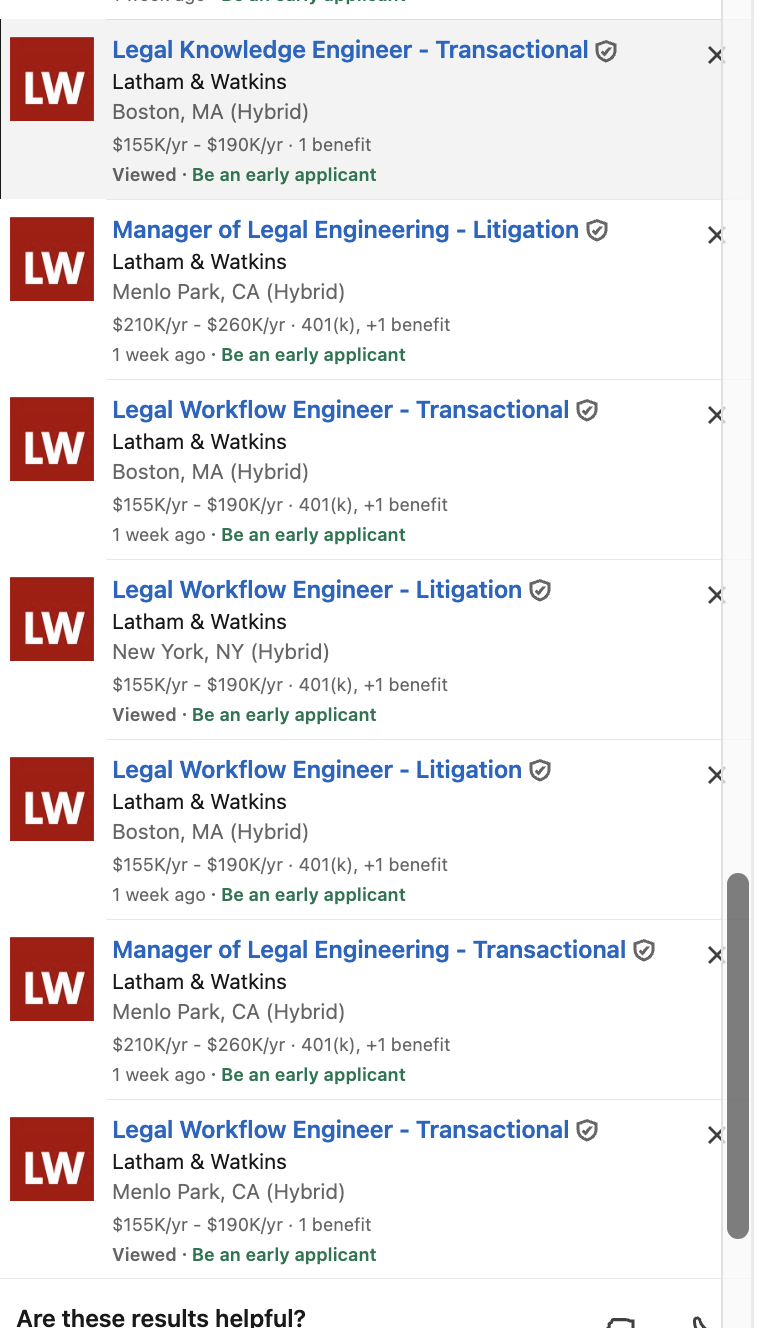
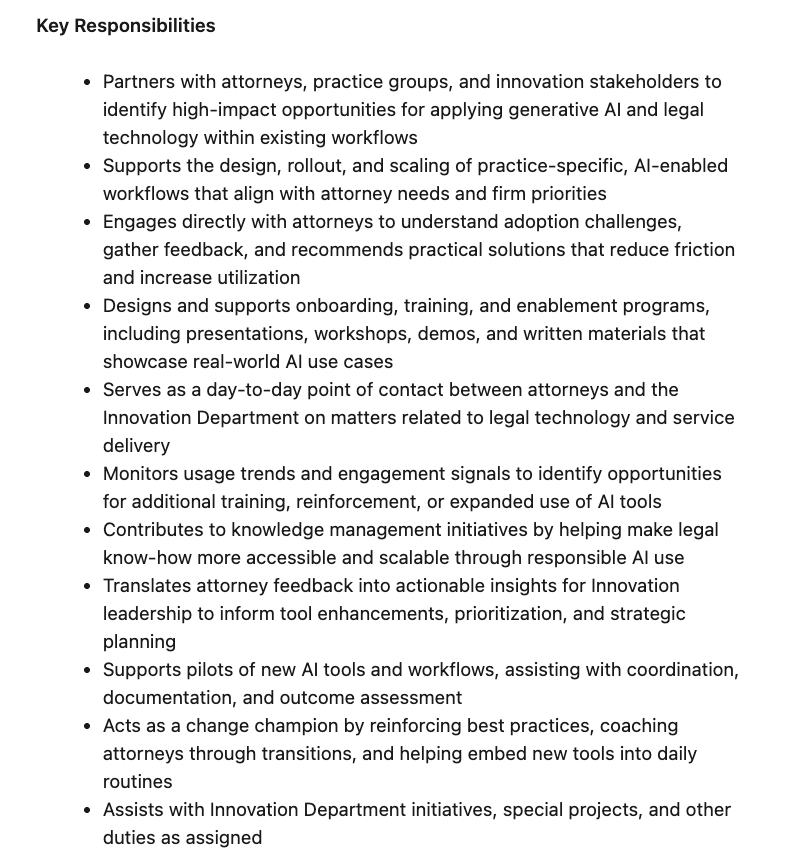
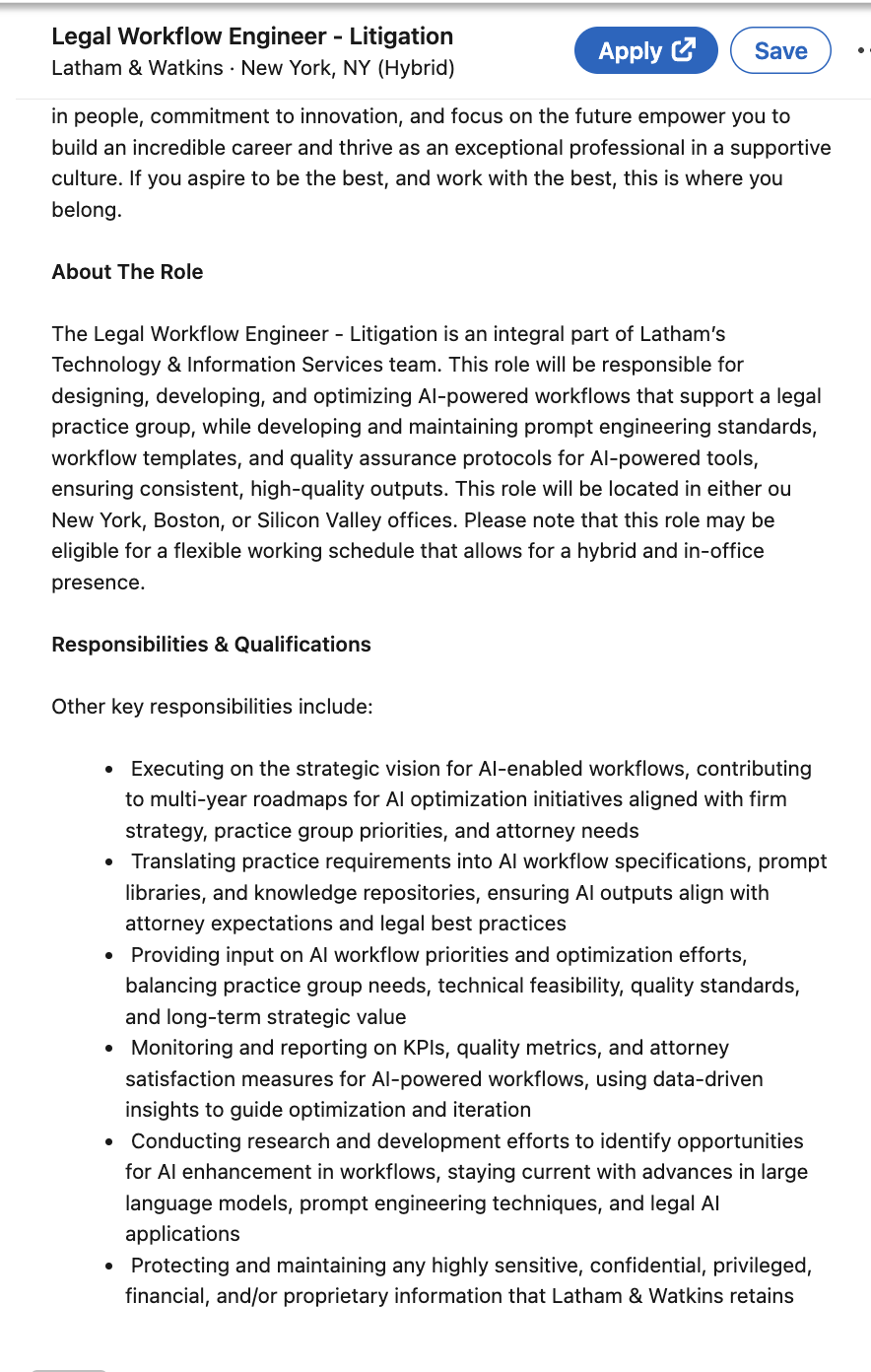
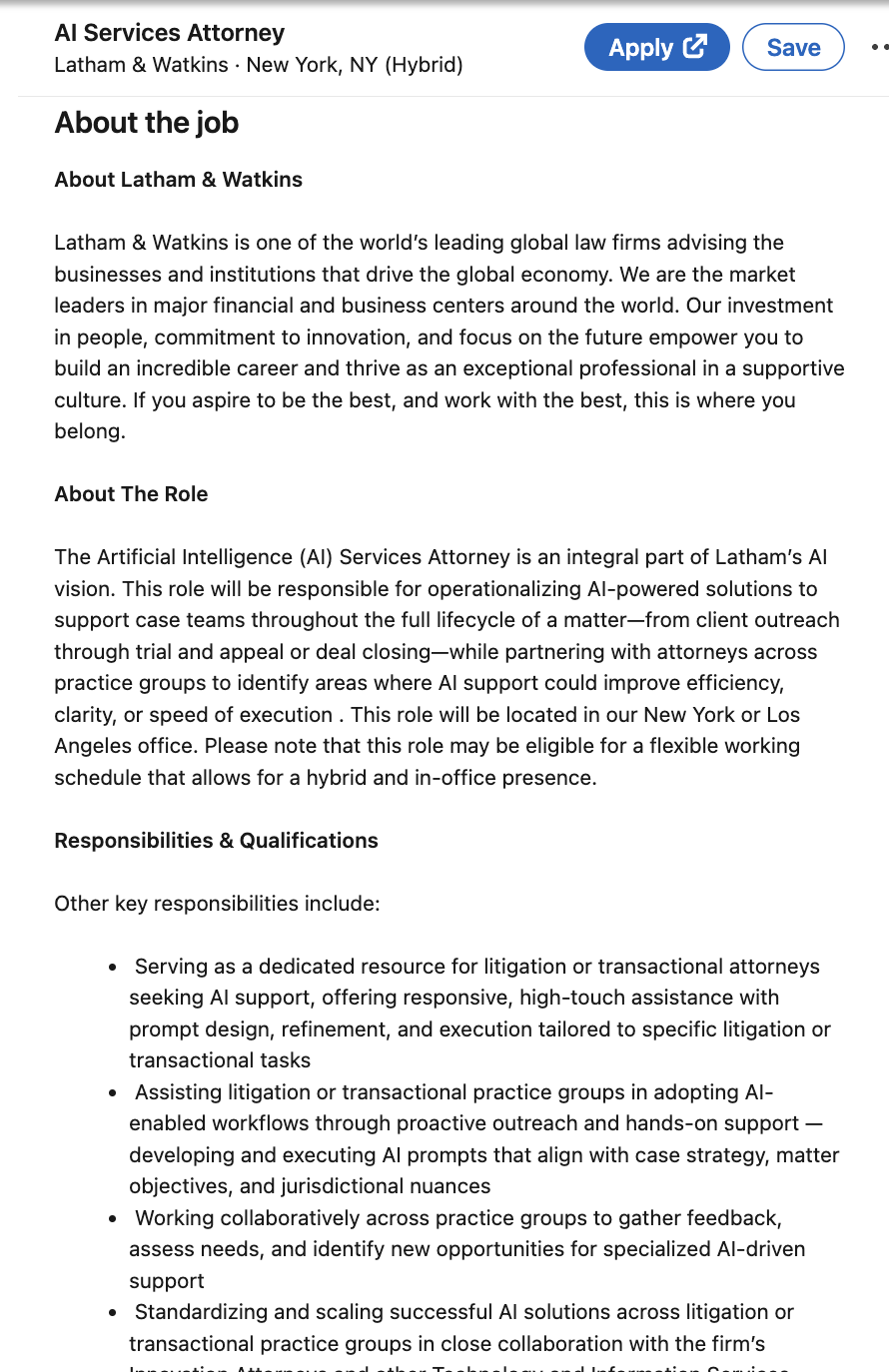
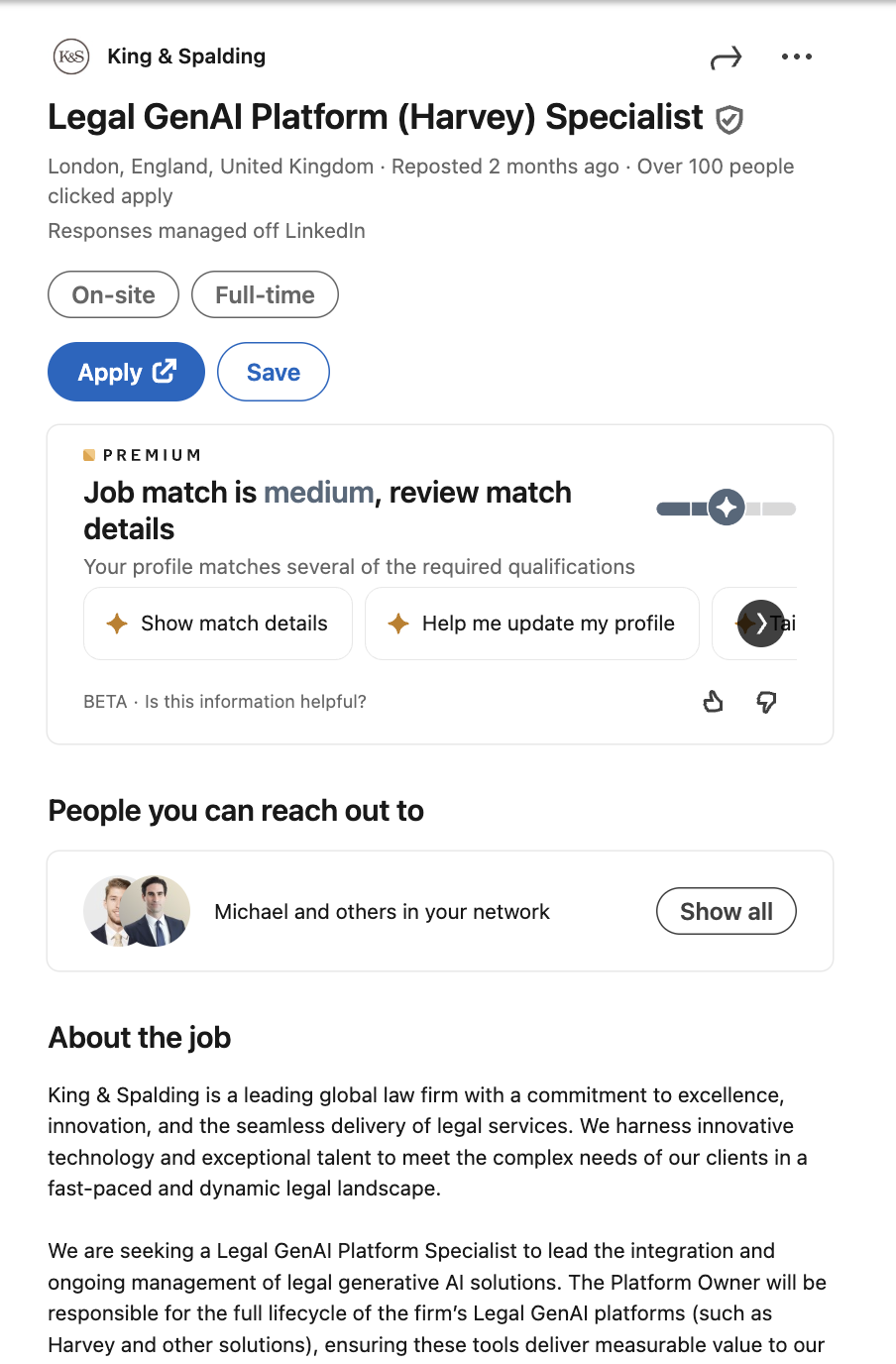
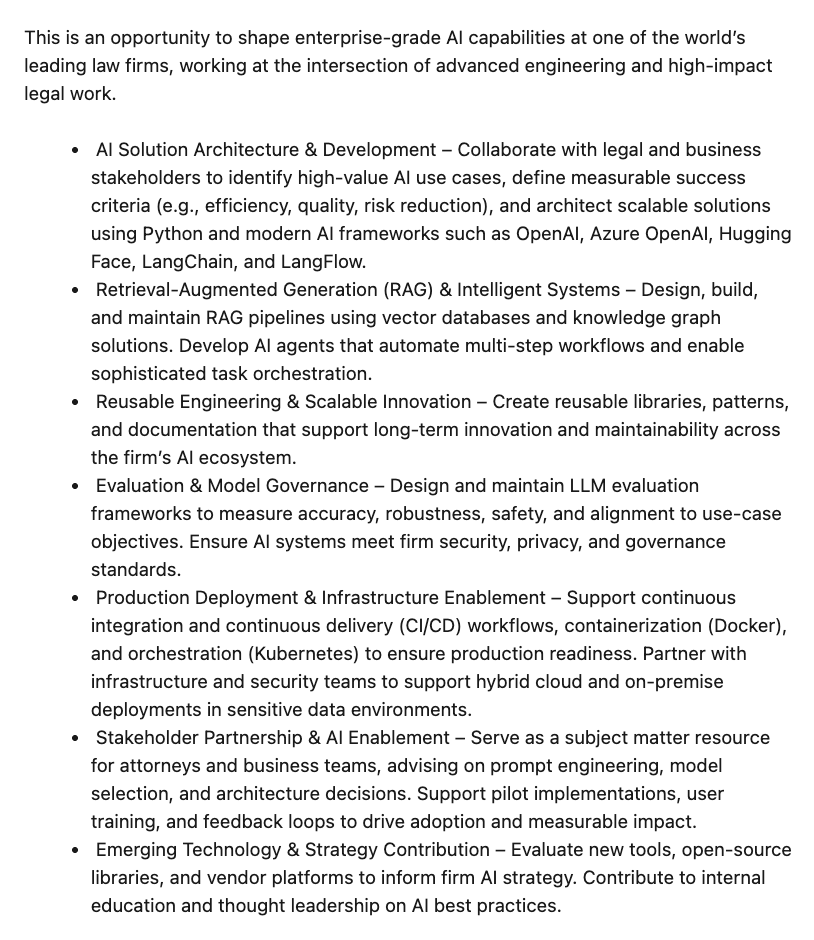
What's notable is the variety of approaches. King & Spalding is hiring specifically for Harvey (the legal AI platform), signaling a bet on a single vendor. Kirkland is building a full in-house AI engineering team from scratch. Latham is creating hybrid roles that straddle legal practice and AI operations. And Clifford Chance is deploying "Forward Deployed" legal technologists, borrowing a concept from companies like Palantir.
3 Hiring is surging, but only at select firms
Not all law firms are hiring equally. Greenberg Traurig has 464 active job openings, which represents 8.3% of its entire headcount. That ratio signals either massive expansion or significant turnover replacement. At the other extreme, Baker McKenzie posts just 65 openings for nearly 12,000 employees (0.5%), and White & Case has slashed its openings by 52% in three months.
The gap is striking: Greenberg's hiring intensity is 16x higher than Baker McKenzie's. This isn't a market-wide hiring boom. It's a tale of haves and have-nots, where a handful of firms are aggressively expanding while others appear to be in consolidation mode.
4 The biggest firms have stopped growing
A clear pattern emerges when you look at the three largest firms by headcount: DLA Piper (13,306 employees), Baker McKenzie (11,951), and Dentons (11,858) all show 0% or negative growth over the past six months. Their two-year growth rates are a meager +2%, +1%, and +1% respectively.
Compare that to smaller, more profitable firms: Kirkland & Ellis grew +19% over two years, Latham & Watkins +12%, and Greenberg Traurig +12%. There appears to be a ceiling effect. Once a firm crosses ~10,000 employees, the global platform model makes further organic growth extremely difficult.
5 Revenue efficiency varies 2.7x across firms
Kirkland & Ellis generates ~$768K in revenue per employee, the highest among the 10 firms tracked and nearly triple what DLA Piper achieves (~$286K). King & Spalding (~$666K) and Latham & Watkins (~$623K) form a second tier of high-efficiency firms.
The pattern is clear: smaller, specialized firms extract far more revenue per head than sprawling global platforms. Kirkland's 8,460 employees generate $6.5B in revenue. DLA Piper needs 13,306 employees to generate $3.8B: 57% more people for 42% less revenue.
6 Tenure signals two fundamentally different cultures
Baker McKenzie's median tenure is 7.9 years, more than double Kirkland & Ellis's 3.6 years. These aren't just numbers; they reflect fundamentally different talent strategies. Baker's high tenure suggests a stable, long-tenured workforce with deep institutional knowledge. Kirkland's low tenure points to rapid cycling: aggressive hiring, fast promotions, and high-performance churn.
Interestingly, the low-tenure firms (Kirkland 3.6yr, Latham 4.3yr) are also the highest revenue-per-employee firms. This suggests that a "revolving door" model, where firms constantly refresh their talent pipeline, may actually drive higher financial performance, even if it comes with higher recruiting costs.
7 Legal hiring is splitting into two camps
The legal function, traditionally the largest category at every law firm, is seeing a dramatic divergence. Greenberg Traurig increased legal openings by +53% in three months, Freshfields by +50%, and DLA Piper by +25%. These firms are actively expanding their legal bench.
But others are pulling back sharply: Baker McKenzie cut legal openings by -66%, White & Case by -61%, and King & Spalding by -29%. When the largest firms are cutting legal hiring while mid-size firms expand, it suggests a structural reshuffling of where legal talent is concentrated.
8 The AI-readiness gap is real, and growing
When it comes to technology infrastructure, the gap between leaders and laggards is enormous. DLA Piper has 610 IT employees (4.6% of headcount), while Kirkland & Ellis has just 34 (0.4%). Greenberg Traurig sits in the middle with 145 (2.6%).
But raw IT headcount doesn't tell the whole story. What matters is the direction of investment. Kirkland's Engineering openings are up +1,000%, building from scratch. Freshfields' IT openings are up +267%. These firms are betting that a lean, fast-moving tech team can leapfrog firms with larger but potentially legacy IT departments.
Methodology
Data sourced from LinkedIn company profiles (headcount, employee distribution, tenure, hiring), publicly filed financial data and Am Law 100 estimates (revenue), and LinkedIn job postings (openings, growth rates). All data reflects Q4 2025 through Q1 2026. Growth rates are calculated over 3-month and 6-month trailing periods. Revenue per employee calculated as latest reported annual revenue divided by current headcount. 10 firms tracked: Kirkland & Ellis, Latham & Watkins, DLA Piper, King & Spalding, Greenberg Traurig, Freshfields, White & Case, Clifford Chance, Baker McKenzie, and Dentons.